Liquidity Heatmap
sweep-reclaim rule · Sep 18
Its mechanical sweep-reclaim rule showed no standalone edge in backtest; on the chart it is read as context.
Now: In use as context
Read the log →Quantitative trading research · built in the open
We build trading models.
Then we try to break them.
We develop, test, break and refine systematic trading models — started on NQ futures, now testing across other indices, forex, crypto and equities — and publish what we find, including what fails.
What this is: an open notebook of trading research. Who it is for: anyone learning to read charts and to check trading ideas honestly. Where to click: pick one of the three doors below.
DATA·STRUCTURE·EXECUTION
A reading aid, not a signal. Read the note on Substack →
Pick the one that sounds like you. You can always come back and try another.
The weekly notes, and examples of our tools on real charts. Start with the bar-by-bar chart on this page.
The development logs, how far each idea has got, and the ones that failed. We publish what fails.
MGE Labs is a trade journal for NinjaTrader 8. It is in private beta, so it is not open to everyone yet. Software only, not advice.
If you are new, this is the order we would read things in.
Step through the sample chart at the top of this page. See what a bar can do compared with the one before it.
Go to the chartWords you will meet: R, edge, backtest, out-of-sample and forward test. Tap any of them for a plain-language meaning.
What counts as evidenceOpen a research log. Some ideas failed our tests, and we say so.
Read a log, failures includedMost ideas don't survive the pipeline. That is the point of it. Choose a stage to see what is there.
Every step is checked against a random-entry control and out-of-sample data, and we correct our own numbers in public when we find a mistake.
Passing the backtest is not the finish line. It is permission to test further.
Fail any one of the four and the result is usually luck, costs or a bug, not an edge.
Last updated Sep 26, 2026. This shows how far each idea has got, not how well it did. It is not a result.
We publish what fails. Most ideas don’t survive the pipeline. That is the point of it.
sweep-reclaim rule · Sep 18
Its mechanical sweep-reclaim rule showed no standalone edge in backtest; on the chart it is read as context.
Now: In use as context
Read the log →retracement rule · Sep 15
The indicator stays, the strategy was closed.
Now: Indicator in use as a map
Read the log →relaxed config · Sep 12
A passing walk-forward test was resting on roll gaps.
Now: Original config, forward test
Read the log →breakout bot · Sep 2
First real test, no edge demonstrated.
Now: Paper bot stopped
Read the log →bar sequences as entry rules
A reading aid, not a signal: our backtests of the bar sequences it names found no standalone edge as entry rules.
Read the log →bar-sequence plan
A template, not a signal: our own test of the pattern lost a little on average on every time frame, so it is read by hand.
Read the log →session VWAP bands
Its mechanical backtest was negative; it stays on the chart only as a picture of how far price has stretched.
See it on a chart →forward testing on simulation only
Our mechanical backtest of the coded rules did not find an edge after costs. A handful of trades proves nothing either way.
Read the dev log →No live results are claimed for anything still in use; forward tests are how we find out.
Our tools on real NQ charts, the good calls and the bad ones. No mock-ups.


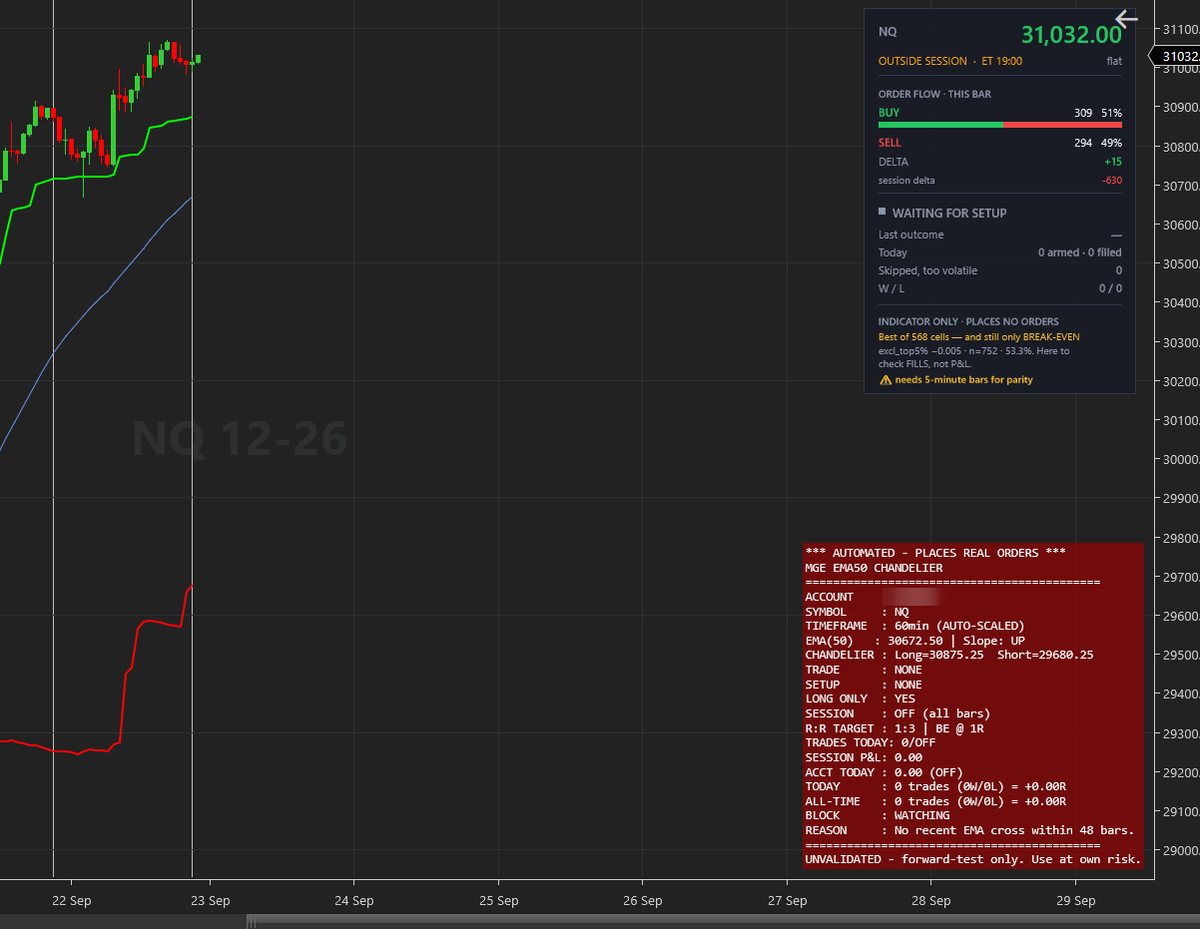


A signal firing shows the machinery works; it does not show an edge.
Historical test vs. current state. A mechanical backtest tests one fixed version of a rule. It can find no edge while the same tool stays useful in a trader's hands, read their own way. We publish both sides.
| Model | Mechanical backtest | Now | Date |
|---|---|---|---|
| Liquidity Heatmapsweep-reclaim rule | No standalone edge | In use as context | Sep 18 |
| IB 25/75retracement rule | 22 signals in ~7 yrs | Indicator in use as a map | Sep 15 |
| MarketCoachrelaxed config | Pass rested on roll gaps | Original config, forward test | Sep 12 |
| Kraken VolSqueezebreakout bot | Negative over 109 trades | Paper bot stopped | Sep 2 |
No live results are claimed for anything still in use; forward tests are how we find out. Read the write-ups →
CSC / AB Trader, our automated breakout strategy, recorded in playback on a simulation account.
How an idea moves from raw data to a tested rule.
The parts we keep testing together: Structure · Liquidity · Flow · Context · Entry · Risk · Execution. The bar is high on purpose: no tool has cleared all four evidence tests yet. We publish every result, pass or fail.
See what passed and what failed →Check an account against its drawdown, consistency, payout and trading-day rules before you take the trade.
Research should be documented, not marketed. We show the process: the experiments, the failures and the lessons.
Our mission →The words used on this site, in everyday terms.
Educational and research content only. Not investment advice. No trade signals are sold or given. Trading futures involves substantial risk of loss. Backtested and simulated results are hypothetical and do not represent actual trading.